Showing posts with label nationalsozialimuspartei. Show all posts

21 June 2009

The City of Fevered Dreams

Some days her shape in the doorway
Will speak to me
A bird's wing on the window
Sometimes I'll hear her when she's sleeping
Her fever dream
A language on her face
--"Fever Dream," by Iron & Wine

Und der Haifisch, der hat Zähne
und die trägt er im Gesicht
und Macheath, der hat ein Messer
doch das Messer sieht man nicht.

An 'nem schönen blauen Sonntag
liegt ein toter Mann am Strand
und ein Mensch geht um die Ecke
den man Mackie Messer nennt.

Und die minderjährige Witwe
deren Namen jeder weiß
wachte auf und war geschändet -
Mackie, welches war dein Preis?
Wachte auf und war geschändet -
Mackie, welches war dein Preis?
--"Die Moritat von Mackie Messer," by Bertolt Brecht in"Die Dreigroschen Oper" (The ThreePenny Opera), this song is now famous as "Mack the Knife." (I chose Brecht's version because it sounds most like the one I heard--it might actually BE the one I heard!)

"You can't describe Berlin, because it's always changing."


With JYM I had the great opportunity to travel with the Resident Director and other JYM students to that *other* German city: Berlin. We met at 9a.m. at the Hauptbahnhof and then hopped on the 9:21 ICE train to Berlin. It was a great travel, just chatting and talking to the other (five) students on the trip and avoiding homework as much as possible. We went up through Ingolstadt through Leipzig and then arrived at the gigantic, gleaming, six-story-high, modern Berlin Hauptbahnhof. This Hauptbahnof is prominent in the first couple of scenes of the recent film The International, and is quite glitzy, a Bahnhof of the future. Our Resident Director (HP) explained to us that, in the Wall Days, there were of course two separate train stations, so after the Vereinigung of Germany, they just decided to build a train station in the middle, but there aren't really any major establishments. So, whereas as in most train stations, you walk out and you are in the center of the city, here it's not so much the case. I could see Alexanderplatz to the south (famous for the Fernseherturm), but there was a lot that wasn't developed.

Interestingly enough, across the tiny road from the Bahnhof was a little platform set up for beach volleyball. Yep, you read it right--beach volleyball. We peeked in to see a couple of bronzed--well, maybe not bronzed---muscled women tossing around the fabled white ball in the middle of a parking lot. So it goes.

What's interesting about Berlin, HP went on to say, is that it is really a city with no center. This must add to the collective Berlin identity crisis. If you look at a map of Berlin, right in the physical center of the city is the Tiergarten--so essentially, there's nothing in the middle. Because of the Wall, there isn't really a center at all. All the "sights" are in some essence crowded around the four corners of the Tiergarten.


We walked from the Hauptbanhof to Hotel Bella (south of the Zoologicsher Garten) where we had a whole half-floor, living room, bathroom, and balcony to ourselves, with three rooms for the six of us. It was quite plush and very nice. We settled in and then headed to get a bite to eat at a Berlin-famous currywurst station. (HP speaks in Ger-englisch, which is amusing to hear. "Wir koennen ein bite to eat haben," or "ja, und wir muessten ein Babysitter (this is a German word) einstellen und den ganzen Abend mit boring people verbringen") We practically marched across Berlin, where we saw All The Sights, most of which don't really come to my mind right now.
Berlin--Berlin. Berlin's a fascinating city, it really is. It's screwed up in the best way. I saw a girl walking down an ordinary sidewalk licking her ice cream cone--this kinda grungy sidewalk under gray skies, and thought about how most of the time, I eat my ice cream on glitzy Leopoldstrasse in beautiful, green Munich and the contrast couldn't have been bigger. We stopped by a sidewalk sale with random Berlin stuff and T-shirts and also a whole rack of German army jackets (and one U.S. army jacket), and one girl bought one with the name "Schoenborn" (schoen=beautiful, and then the nice word "born") for 25 euro. He must have known he'd get a good price for that last name when he sold it to this store. They also had the hugest collection of second-hand leather jackets in very good condition.

All the shops we walked by weren't Munich schicki-micki at all, but really cool. Just selling the niftiest stuff, cool, not kitschy. DDR-influenced fashion: leather jacket top with a pastel floral skirt and Birkenstocks in the storefront windows, minimalist dresses, NEAT quality postcards (one had a brick wall with a closed rolling metal window gate thingy that said "URLAUB" --vacation--on it). A row of beautiful buildings, then an schrecklich grey building with "KAPITIALISM ZERSTOERT . . . . " (capitalism destroys--then listed several good things we like to have in our lives, like normality, freedom, etc). These people don't want to cooperate by making things all Stepford for the others. Definitely not a Munich trait.

We saw the Kaiser Wilheim Memorial and its opposing (protestant!! We're in the North now) modern church--really gorgeous, with most of the walls covered in blue stained glass pieces. When the sun shines--if that happens in Berlin--the whole building glows blue. On the way over, I noticed a Muslim woman and her male counterpart trying to do the old windshield-cleaning at stoplight gig. One man honked furiously her, rolled down the window and called her over, and shook his hand in anger as he exchanged some heated words. A man driving a BMW wagon talking to a female in the driver's seat tried to wave her off, didn't give her any money, then engaged the wash on the car to try to get the muck off.

I can certainly tell you that. Would. Not. Happen. in Munichland. I can't even *imagine* windshield cleaners here. The concept is unvorstellbar. Berlin had so many beggars and was a much poorer (but also cheaper!) city than Munich. Restaurants of every variety--Russian across from the Armenian, Chinese, Vietnamese--you name it, it's in Berlin. Immigrants of all kinds.

At a quarter to 8 we walked over to the Admiralpalast, where the German-language version of the Broadway hit The Producers was showing. Let me tell you, THAT was a weird experience: the Nazi eagle flying around in a little animation spiel, the famous long red flags (with a black pretzel where the swastika is--displaying it is, understandably, illegal here) hanging outside the building. We got into the beautiful (if more than half-empty, but I think it's been there for a couple of weeks) building, and the show commenced. I was intrigued to see what the Germans would find funny, and that part with the Hitler-saluting pigeons they seemed to really enjoy. However, when the "show" within the show started, the over-the-top swastika formation, the practically naked woman with the Nazi eagle on her crotch, the gigantic "SPRINGTIME FOR HITLER"--people laughed, but not so much. (Interesting article: "Can Hitler be a Hit? Musical 'The Producers' takes the stage in Berlin" agrees with me about the playwright character) I was suprised by the number of older people there. They probably aren't old enough to have been directly involved, but someone in their 70s would remember a little of it. The younger people seemed to find it funnier. . . . It's a great question of how one deals with the past and especially a history that has earned (rightfully) so much shame--Nazism was no fun, and Denazification was no fun, either.
After that we wandered around one of the major streets of Berlin, where several huge differences with Munich came to light (haha). There were about 2 sluttishly-dressed women with fanny packs per block, standing around and looking at the men walking around. We overheard one conversation in English, where the woman was saying, "We have a big bed, you can relax and do what you want." I could not believe it--prostitution! In Germany! It was certainly not the Germany I knew, the conservative Catholic Bavaria. My eyes were just popping wide open as I gazed at these women.

We walked into a really interesting art house/cultural center place. I realized I felt a little strange, and this was because I am totally unaccustomed to being in a *store* with *items for sale* when it is dark outside. Everything in Munich except for food-service places (cafes and restaurants and bars, not grocery stores) shuts down around 8 PM if not before (strict Catholic laws in Bavaria), but this is not so much the case in Berlin. I even saw VIDEO STORE in the area of our hotel that was open on Sunday from 12 to midnight!!!!!! I mean, a video store! Totally a non-essential. Wow.

Behind the cultural center they were doing this sculpture-making welding, with actual fire, ala Chris Stevens from Northern Exposure. It was a sculpture garden and continued with more tents and such selling art (bear in mind, this is after the play, at around 12 midnight). Plenty of people (of the sketchy and non-sketchy variety) were walking around to look at the art. Really weird.

After that, we went to Route 66 near our hotel (open until FOUR IN THE MORNING), an American diner. They had very good milkshakes. I ordered a chicken sandwich but they put egg in it. I personally find the presence of eggs in my sandwich so revolting it's kinda turned me off to eggs in general. I don't want two chicken products, at once, please. That's like eating a hamburger with milk. But the rest of the chicken, sans Ei, was good. It was a nice restaurant, really chill, great lighting--and American food.
We had a long conversation about different types of fries and their respective advantages and disadvantages for ketchup-dipping and Brandy said, "HP, can you tell we want to go back to America?" Of course, the other five JYM'ers were full-year students and in general seem really attached to Germany. I think most of them are anxious already to visit America for a bit and then come back for an extended period of time. I do wish I shared their attitudes, I've always admired those able to "go native" and immerse themselves in a completely foreign culture and begin to not only understand, but become "The Other," that concept we're always mangling about in our liberal arts university. It's probably largely a matter of choice and just throwing yourself into it. There are parts of Germany I really like (and I did like Berlin and its more American-style city--disadvantages include poverty--but I also like Munich, which is a great beautiful city but comes with its own disadvantages, like the city being shut down at night and on Sunday), but I'm someone who requires 7 days a week store openings (for most stores) and bright lights to be happy. I like going to the Starbucks in the Quarry Market and not worry about what the eff day it is, or what time it is, because that Starbucks is going to be open come hell or high water (being a 24 hour Starbucks). So, too will the Borders' Bookstore across the way, from a very generous 9 AM to 1o or 11PM, Monday through Sunday, and it will most definitely be open on all holidays. And that's just the opening times, I haven't even gotten started on how much I generally prefer American standards of interaction. If my choice was Munich and my Louisiana town, I'd choose Munich in a heartbeat, but thank God there are more cities in the U.S. more to my liking, on the San Antonio scale of things.

We totally crashed at the hotel until the next day. On Saturday we hit more sights, went sans HP and got utterly lost but found our way back again (go team go!), finally rendevoused with HP at a Flohmarkt, which had some interesting things and was actually a NEAT flea market with lots of great quality stuff. No prices--totally open to haggling. I kinda prefer to know the price beforehand, though, but still.

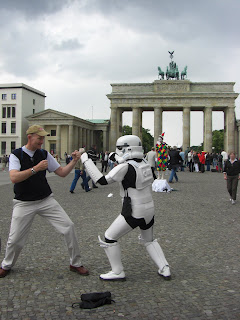
We saw even more sights which I can't exactly remember--Potsdamer Platz near the site of the Wall due to our getting off course--Humboldt University, Rotes Rathaus, a memorial to the victims of Nazisozialismus (weeping woman with her dead son), Brandenburg Tor (where we had a little picnic in full view of the Tor, and HP and some others posed with a Stormtrooper in front of the gate--like I said. Berlin's a weird place.). We ate lunch thanfully under the full cover of trees, since it was pouring down rain and like 55 degrees. Then, about 30 minutes later, the sun was shining and the skies were clear. We had decided to give our leftover food to a homeless man since we wouldn't need it for the duration of our time in Berlin, and we went to the bathroom in a lovely Kunstmuseum (I mean, nice, clean, state-of-the-art lobby). An immigrant family surrounded a couple of members of the group (in the lobby) and asked for food or money, so Sheeba gave the food to them, where they ate it in the lobby. See what I mean? A city of contradictions---this state of the art lobby juxtaposed with this immigrant family eating our leftover food on the steps inside the lobby. Just a strange city.

We had a Kaffeepause in a "little old lady cafe," the Opercafe adjacent to the Berlin Opera, which was gorgeous--4 euro slices of beautiful cakes, the BEST Eisschokolade that I've ever had (hands down), teas. We all ordered a drink and a Kuechen and sampled each other's cake. The cafe was this ornate, chandalier, pink-and-green, maple wood style cafe. And just earlier that day we had walked into this Yuppie, Starbucks-style coffeehouse, and later that day I'd walk into this cafe hole of dank Communist memoriabilla. The contrast couldn't be greater if you tried. Berlin is most certainly a city with an identity crisis, a city in constant flux, a city of so many transients (people consider themselves "Berliners" if they've lived there for 3 or 4 years and very few Berliners are natives) that it really can't have an identity because the face of Berlin is always changing.

We went off to see the Pergamon Museum, which was fascinating. After that, we split up, and I went off with two others to find a little cafe spotted during our walk. In the end, it turned out to be a slightly smelly and empty Communist-memorabilla cafe, so we decided to go ahead to the rendevous point, Depointe (sp?), which was this awesome cafe. Julie and Dan ordered the bier, which of course in Berlin is something that would cause the Southerners to foam at the mouth in anger: it comes in red and green, like a -tini or something, and is actually quite tasty. I ordered a nice Earl Grey tea and a tortellini in cheese and filled with spinich, which was very yummy. The weather was nice enough to sit outside in the 'backyard,' a very very tiny piece of a garden here in the big, bustling city.

After Abendessen we went ins Theater to see Die Dreigroschenoper (The Threepenny Opera) by Bertolt Brecht in HIS OWN HOME THEATER, the Berliner Ensemble. Talk about cool, cool, cool. The play was done in a Tim Burton style, which was totally up my alley. Mackie walked across the stage with his back to the audience as "Die Moritat von Mackie Messer" played and the criminals walked across the black canvas with circled-lights being illuminiated--I didn't describe it well, but I bought the program, so if you know me, ask and I will show you, because it is really cool. It is probably one of my Top 5 shows I've seen. Mackie walked with a walking stick dangling off his hand then finally turned around to reveal his Joker-white face and firey red hair. Just so cool. The play was done in a super-minimalist style, with these shelves of neon lights used for most of the setting, and sound-effects plus actor imitation for all the "gaps," such as doors opening, change jingling and such. Most of the main characters had their faces painted this pasty, Joker white color. . . . and the ending was actually "happy" but apparently it's a parody. Of course, it's Brecht, so the entire play is a critique of capitalism, but how awesome to hear this critique in Berlin, where capitalism and communism stood as actual physical divides?

(Note: Theater could benefit from installation of air-conditioning. I always think of theaters as dark, cold places. This is not so in Europe. Dan and I thought we were going to pass out and immediately ran out for air at intermission. I enquired with HP about why there is no AC in Europe and he said, "Wir brauchen es nicht." We don't need it? I think we most definitely do.)

After the gloriously done production, we posed for pictures with Brecht's statue outside and then headed back to the hotel. (Side note: Germans never give standing ovations, even at this amazing, signature Brecht piece in Brecht's theater. I don't know why this is. Would it be too much enthusiasm in this postmodern world?)

Sunday we brunchten at a little Italian cafe. Brunching is a popular Thing to Do in Berlin. I think you can probably brunch in Munich, but here almost every restaurant advertises its Sunday Brunch. After that, we left HP to go look at the famous multi-block Holocaust Memorial, taking a double-decker bus pretty close to the site. The site pretty much resembles a graveyard, and is actually a great experience. I walked through part of it, where the blocks get higher and higher and you can't see your way around as much anymore. It was a very well done memorial and I'm glad I got the opportunity to see it. Then, we hopped on the M41 to Hauptbahnhof where we arrived in perfect time to meet HP at our Gleis in Richtung Innsbruck. 6 1/2 hours later, our little group of 7 arrived in our quiet, still corner of Germany.

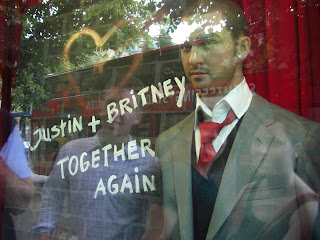
Photos: (1) Berlin t-shirts at a sidewalk sale while walking around Berlin (2), Sheba is ready to go at Muenchen Hauptbahnhof (3), German National Museum--"German History: We are one people," (motto of the Wiedervereinigung of Germany) (4), HP fights Stormtrooper in front of Brandenburg Tor--I told you Berlin was a weird place (5), DDR fashion (6) Alte Computers for sale? (7), Admiralpalast decks out for The Producers production (7), Justin & Britney are together again at Madam Tussaud's in Berlin--my pre-Kevin Federline knowledge of Britney is so much faded I forgot this match ever was.

10 May 2009

The Sorrows of a Young Mädchen


Thursday

On Thursday, I had decided to get Out and About. There was one church that I hadn't seen in Marienplatz, and I'm a big believer in leaving no church unseen, so I decided I would see Heilige-Geist-Kirche and then perhaps leave my day open for going to the top of Frauenkirche. I went over to Viktualienmarkt first and bought a delicious Schmalznudel, a fried-dough-and-sugar-concoction, from Cafe Frischut. I ate it on the short walk over to Heilige-Geist-Kirche. The church had no services going on, so I walked in and looked around. Very shortly I was accosted by an old German man who grabbed my hand and put a medallion of Maria in it, and proceeded to go on. and on. and on. and on. about Mary and Mädchens such as myself. Those were the only two words I pretty much understood; everything else he said went totally over my head. I just nodded like a fool. Then he asked me a question that I didn't understand, and I just said, "Nein," and he said, "You don't know your Theologie?" in a voice expressing such shock that the state of my soul was even worse than he feared. I was like, "uh, well, uh, I have to go. Bye!" and then freed my hand from his grasp and walked out, n'er to return. I was really shaken by the experience. It bothered me for some reason, as funny as it was.

After that, I decided to go up Frauenkirche, so I paid my little entry fee, climbed up a couple of flights of stairs, and came to a large landing with an elevator to the top. There was an Australian couple with me, so I interrogated them about Australia and they seemed receptive and were very kind. They were quite shocked that I was over here alone, even with a program, living in a German dorm, away from my parents back in the U.S. It was very kind; they exuded a sweet caring vibe. The man gave me his phone number and address and told me if I ever wanted to see Kangaroo Island (as I had mentioned to him earlier), they lived just near the ferry to the island. It was uplifting.

Then I decided to go up and see Altes Rathaus as well---so I went over there, paid my entry fee, took the lift up to the top. I liked Altes Rathaus because it was outdoors and right in the center of the action, literally the heart of Marienplatz, so I could look down at the Renter's Party protest against raised rents and the various tour groups meeting up.
I went over to Karlsplatz to see what was happening and found an Israel Tag celebration going. I hadn't realized that it was the anniversary of Israel's Independence Day. The whole scene was fascinating--Israeli flags everywhere, little booths set up alongside Karlsplatz selling Israeli things. Amazing how time changes things. These people were coming out and saying, "We're Jews." 60 years ago, in the very same spot, they would have been killed for it. A board proclaimed the history of German-Israel relations: apparently 2/3 of Germans consider the state of Israel the greatest threat to world peace.

Inspired by this, I looked into my guidebook and said. . . hmm. It's time to go to Dachau.
Dachau
I took the 20-minute S-Bahn out to Dachau. My guidebook suggested taking the bus out to the KZ-Gedenkstätte, the concentration camp, but I was like, "meh! Everything's close in Europe."
55 minutes later, I arrived at the Gedenkstätte.
Admission is free, but the audioguide is 2 euros (reduced for students), so I got that. I couldn't believe how huge the place was. The photo I have up here shows the famous gate in Jourhaus Bridge through which prisoners entered the work camp, "Arbeit Macht Frei," or "Work Makes You Free." Behind the gate you can see a huge area: this was the roll-call area, and at the height of the camp, would hold 40,000 prisoners.

The Maintence Building in the center of the camp has a large exhibit in it. Behind the Maintence Building is the bunker, or punishment cells. I was in the bunker by myself, and it was utterly creepy. I half-expected to be thrown into a cell myself. The entire Western Wing is open, so you walk along and along and along the hall past all the cells, which have their doors still intact and their numbers above it. Some of the cells had been broken up into fourths to torture people by putting them in a cramped space with little light or air for days on end. However, when the Americans liberated the camp, they were so revolted by this they smashed all the divisons and kept the cell itself intact. They did use the bunker as their own jail for a short time--note, "jail," not "torture center." As I approached every cell, I expected to find a screaming, bloodied person behind the door. . . really creepy.

I went over to see the barracks, which stand on the other side of the Maintence Building from the roll call area. Even the arrangement of prisoners in the barracks lined up to Nazi racial ideology: Germans and Western European prisoners were housed in the first barracks, with it getting progressively "worse": the Soviets, the Poles, and of course, the Jews at the very far back. All of the barracks, except two, have been dismantled, but there is a concrete outline of the barrack structure filled in with gravel so you can still get an idea of the place. I went into the barrack to see the living conditions: just beds stacked as high as possible, like chicken cages. They soon ran out of little boards to divide the beds, so many bed structures were just large boxes were people had to sleep crammed head-to-toe.
At the back of the complex are some religious memorials.

It wasn't a chilling experience, but it was an eye-opening one. In my German literature class, we read this book called Tonio Kröger by the famous German author Thomas Mann, in which the protagonist, Tonio, is the child of Slavic mother and a Nordic father. His best friend, Hans, is "blonde and blue-eyed," and you can see how he envies Hans; the girl he loves, Inge, is also tall, blonde, and blue-eyed. A friend joins Tonio and Hans on the walk back from school and calls Tonio by his last name, "Kröger," because his first name sounds so "foreign." The book was written in 1906. It's the failing of homogenous societies. They may be nice, and safe, because everyone essentially one huge family (thus socialism works very nicely) but they have some severe shortcomings which I couldn't accept in my native country.

Photo: Photo from Altes Rathaus. Also, please note that the title of this blogpost, "The Sorrows of a Young Mädchen," is a funny (to me) reference to Goethe's work of a similiar title, The Sorrows of Young Werther.

America, America, America.

05 April 2009

Oh, let the sun beat down upon my face

Oh, let the sun beat down upon my face, the stars to fill my dreams
I am a traveller of both time and space to be where I have been

To sit with elders of the gentle race, this world has seldom seen
They talk of days for which they sit and wait and all will be revealed
--"Kashmir," by Led Zeppelin

Photo: Angel statue in Nordfriedhof

Nymphenburg, Muenchner Freiheit, & Nordfreidhof (Freitag)

I've had quite the weekend. On Friday, I headed out to see Schloß Nympenburg, the summer palace of the Wittelsbachs, built in the late 17th century. It's a little to the east of town, slightly out of the way. I think there is a bus that goes very close to the castle from the Rotkreuzplatz U-Bahn station, but my knowledge of the bus system is lacking and I didn't do any further research. Photo: Schloß Nymphenburg with swans.


It was a beautiful day for Nympenburg. I followed the canal all the way up to the palace, which completely encompassed the grounds. It was stunning. Swans swam in the lake in front of the grounds, dogs ran around. I had lunch in the Cafe Palmenhouse, behind and to the left of the palace, which was nice--there is a snack bar there as well. The palace itself is stunning---particuarly beautiful was the large white-with-gold-inlay- ballroom in the center of the palace, with a high ceiling painted with clouds and rainbows. I wanted to spin around the floor in a long, swishy dress. Also striking was the Schoenheits Gallerie ("Beauty Gallery"), which has portraits of (mostly young) women from all classes and stripes, commissioned by King Ludwig I (I tell you, that man was busy! Between working with the university, the library, having portraits of beautiful women commissioned, as well as a statue of himself on practically every block of Munich--I exaggerate, but still!) and hung in this wing of the palace for his personal enjoyment of female beauty, which apparently fascinated him. I suppose one can tell this was in the days before Internet. The grounds behind the palace are even more stunning, so many little gardens and statues and gorgeously kept.


I walked around Nymphenburg some more, walked back down through the suburbs, had an ice cream, and decided to take up a suggestion from my guidebook: to look at Herz-Jesu-Kirche, a very modern Catholic church built in 1998, not far from the Rotkreuzplatz U-Bahn station. Upon the first look, it is a dark blue cube. But the dark blue is from the tiny little mosaics of "nails as crosses." It was very pretty. Inside, it was very light, and open. There's another "cube" inside blue cube, which has the church proper, and alongside the church proper was one of the most fascinating examples of contemporary church art I've seen: the Stations of the Cross (divided on each side) or the Kreuzweg as black-and-white photographs printed on an almost transparent material and mounted on large silver stand-alone frames. All the ones I recognized were from Jerusalem, photos of people with the architecture depicting that Station of the Cross. I"m not explaining it well, but for example, when Simon helps carry the cross, there was a b&w photo of a gate in Jerusalem alongside the Via Dolorsa which has that station engraved over the stone gate. It was really, really cool. I would have never thought about the Stations of the Cross in that way, but the change was very refreshing. Photo: Ballroom in Schloß Nymphenburg.


After that, I hopped back to Sendlinger Tor, took that one to Muenchner Freiheit, and decided to walk all the way from Muenchner Freiheit to StuSta, since it was such a pretty day. It was about a 2 mile walk, and utterly worth it. I truly believe you don't get the feeling of a city until you've walked it. I stopped by the charming Erloeserkirche, which is actually an Evangelical-Lutheran church. It was really intriguing to see the difference (and the similiarities) between this church and all the Catholic ones I've been seeing: there were still crufixes, but more emphasis on writing/reading than images (the Beatitudes were written along the columns, which one wouldn't normally observe in a Catholic church), and, despite the stained glass, it still had a distinctly Protestant feel (you'll laugh, but the presence of carpet has a lot to do with it!). Someone was playing the organ and I was the only one wandering around, and I had a feeling I wasn't really bothering anyone--which isn't always the case in Catholic churches I've been into. It seems like Catholics see their churches less as buildings and more as places, while Protestants tend to view it in the reverse: the building's only as good as the people in it, no people in it, you're not bothering anyone. Photo: Erloesherkirche in Muenchner Freiheit.


Maybe Protestants (modern ones, anyway--historically, Protestants are quite literally iconoclasts, icon-breakers) have a better feel for the distinction between religion and art, while Catholics tend to view the church art as an aid to worship, and not meant to be viewed as art alone. Hmm. Insert tangent re: iconoclasts, Protestant destruction of English religious art, what does that mean, etc., here.


What was also very fascinating about this church was a memorial of the names of soldiers who had died in World War II. Yep. German names. World War II. You know what that means. I can't tell you how odd that feeling is: being on the other side of the WWII fence. Usually, when I view a memorial of American/British/Allied soldiers fallen in WWII, I'm thinking, oh, those brave men who were killed by evil, power-hungry Nazis! And now? Wait. . . . the Allied forces killed those people named there. Maybe some of them died of gangerne or scurvy. It's amazing, though, what time heals, and how quickly. It's been, what, 63 years since the end of the second World War? And here I am, an American, quite amicably studying abroad in a city utterly ravaged by bombs my country and her allies dropped just over half a century ago. Of course, I probably owe a lot of that to the Denazification (Entnazifizierung) of Germany implemented by the Allied forces.


I walked all the way to Nordfriedhof, and decided to walk through the cemetery, which is huge! Some of the graves were so beautifully done, and there were women about everywhere, bringing in fresh flowers, cleaning down the tombstones, and it was the perfect time of day: about 5 o'clock, still light but not overwhelming, and so quiet and calm! I definitely want to explore Westfriedhof, the other cemetery near Nymphenburg, and I'll certainly walk through Nordfriedhof again.
Photo: Two ladies talk in Nordfriedhof.


Regensburg (Samstag)

Saturday was our group excursion to Regensburg, a town northeast of Munich, near Nuerenburg. It was about an 1 1/2 hour train ride. I'd go into how civilized trains are, and how much I enjoy train travel, but most of you know my feelings. It's just so darned simple! Walk to center of town. Get on train. Get off at center of town. Go where you want. Regensburg is a looooooooooovellllly town. A perfect size: I think about 10 or 11,000 people. We had a tour with our fearless leader, a professor from JYM, through the city, and then were let loose for a half hour or so for lunch. I grabbed lunch and hit the church circuit. I, visited St. Josephskirche, which was one of those churches with the gates-around-the-narthex deal (old form of protection?), and so my photos of the gorgeous church were somewhat limited. It was odd, though: there was one man sitting toward the back of the church (closer to the narthex), and a lady who had walked in front of me tried to get his attention by waving, and then she made several bows from the waist, almost jamming her head against the gate, when she finally got it. He exited the pew and I did a double take: he was clad in a long, dark brown gown. Sometimes I feel like I am in a history novel. Being from such a Protestant, "new" country, I'm not quite accustomed to so many remnants from the past walking around me in friar form, as if I have accidently wandered into a Shakespeare play. His long habit swished over the floor and he disappeared from sight via a side corridor, and the lady disappeared, too (see? Shakespeare plot begins).

I also went by Alte Kapelle, which is right across from St. Josephskirche, and that was a gorgeous church, again with the gates-around-narthex feature. I bought a couple of postcards from the stand in the back, just as a "I was here" memento to myself, and I always pick up a brochure or leaflet from the church proper, because, to be honest, it is a lot of churches, and if I don't take care to get something from each church, they'll all blend together.

Then we rendevous'ed for a tour of the Dom. The Dom is HUGE. STRIKING. HIGH GOTHIC. I peeked in about 10 minutes before our tour, so I wouldn't be hindered by a group for a little bit. I had to take a moment to collect myself when I first entered into it, and I've been into a lot of churches across Europe. It's better than Frauenkirche in Munich, hands down. The tour was great, and gave us so much information about the detail in the church, which has just been added to over the centuries, but built around the mid 1200s. Gosh. It was so beautiful! And so Gothic and dark inside. The Dom St. Peter is a place of pilgrimage, apparently.
Photo: Dom St. Peter


After the Dom tour we headed over to the other side of town. We walked by another Evangelical-Lutheran church, across from which was a Protestant academy, which had, of course, a carving of Martin Luther guarding the doors, and I shot a photo of him. We were headed to see a castle of the Von Thurn und Taxis family, who were the postmasters for the Holy Roman Empire and were elevated to nobility by the same powers. Albert Von Thurn und Taxis, aged 29, is one of the world's most eligible bachelors. The castle. Is. Something. Out. Of. Fairy. Tales. It's got the perfect amount of decay in the stones, and the grounds were surrounded by lush, lush green grass and an ABUNDANCE of blue, blue flowers. As one member of my group put it, "It looks like it's been digitally retouched." The castle is still a private residence of the family, and as such isn't available for frolicking. Sad. But there were images in my head of myself as Christine von Thurn und Taxis, (nee Cavin) maybe playing with my little von Thurn und Taxis out here on the grounds. "I married you just for the castle," is a good enough excuse, right? There is a museum of the family, but we didn't get to see it. Regensburg is certainly worth another visit. It needs it. We stopped by the St. Emmaumskirche, which was, again, jaw-droppingly beautiful, but they were having Saturday evening Mass. A couple of us peeked in for a further look. It was gorgeous. Photo: Von Thurn und Taxi 's castle, with blue flowers on the grounds.

We headed back to the Bahnhof to catch our train back to Munich. A couple of us girls had to use the restroom, and so we went off to find it, only to realize each stall was guarded by a stall asking a 50 euro cent toll to use the restroom. European cruelty at its worst; it was hardly the Ritz of bathrooms. I had used my last 50 cents to donate to an accordion player in the Regensburg plaza, HELPING the Regensburg economy, and now they wanted me to pay-to-pee. One of our number, much more adventrous than I, put her foot and hoisted herself up on a shelf next to the stall, scaled the stall, and, as she came down, kicking the latch open from the inside as she went down. I was so impressed. That is a major benefit of group travel/interaction: sometimes people have different M.O.'s, and can shock you into realizing another perspective--and you can carry that knowledge/experience with you forward in life. As a result of our one-stall-usage, we had to book it for the train, but you know what? Whenever that happens to me, I just feel really alive.


The following is an entry from my journal yesterday as we rode back:
"The setting sun's light slants over green, green fields where deer nosh in small groups. The half moon is a white smudge in the blue sky. Forests, fields, small towns, a group of friends having a picnic over a gorge are all part of the view outside my window. Rolling hills punctured by onion-domed churches. 'How happy is the blameless vestal's lot! The world forgetting, by the world forgot. Eternal sunshine of the spotless mind!' (Pope)"

Wandering in Englischer Garten (Palmensonntag)

Journal entry from today: "All the advertisements that said: "endlich Fruehling in der Stadt" (finally spring in the city) as it snowed down on Munich have seen their prophecy fulfilled. I sit on a green bench, the streets empty because this weekend marks the first sunny weekend in what must be a long time, and Munich celebrates by bringing their significant others, strollers, dogs, children, and bicycle into Munich's expansive backyard, the Englischer Garten. Jackets are slung over shoulders, young Golden Retriever puppies rejoice in their first spring as they bound through the grass, families rent boats from the boathouse, the young girl, perhaps not yet burdened by the world, happily steers as Mom pedals and Dad directs from the back."

I had just grabbed an ice cream cone in Giselastrasse and saw a sign that said, "Englischer Garten: 0,5 km" and decided to follow it. That's what I love about Europe. It's just so set up for spontaneity. I sat on bench alongside the boat-cluttered lake, people-watched and journaled. I happened to be sitting in front of a pretty swan at lake's edge who was attracting a lot of attention. An Asian man with an expensive Canon DSLR spent quite some time crouching along the edge taking photos of the swan, and someone's Collie came up to him and was at his ear before he realized it was there! He jerked back, scaring the dog backward, and looked at the dog's owner (now laughing) with a funny "I almost had a heart attack" expression, and the dog's young male owner just laughed and said, "Er hat mehr Angst!" (he was more afraid!) It was a hysterical moment.


Closing words from the movie Sabrina:
" I came here from Provence alone, uneducated, for 6 months--no more than that, a year--I sat in a cafe, drank coffee, and wrote nonsense in a journal, then suddenly it was not nonsense - I went for long walks and I met myself in Paris. You seem embarassed by loneliness, by being alone--but you see, it’s only a place to start."

27 March 2009

Die Weiße Rose


The White Rose was an anti-Nazi student resistance group centered at Ludwig-Maximilian Universitaet, the university which I'll be attending in a few weeks. Today we watched the German-language 2004 film Sophie Scholl: die letzen Tage (the last days), which documents the experience of Sophie Scholl, her brother Hans Scholl, and Christoph Probst as they faced arrest and execution by the Nazi regime. (Yes: I live on one of several streets in the StuSta named for the members of White Rose--Christoph Probst crosses Willi Graf in the center of the StuSta, another member.)

The White Rose wrote 6 leaflets in the time frame from June 1942 to February 1943, quoting from Schiller, the Bible, what have you, to make an argument against the Nazis, and the organization was centered around the distribution of these leaflets. The photo to the left shows the engraved leaflets that lie on the ground before the main university building in now Geschwister-Scholl-Platz (the Siblings Scholl). The Sixth Leaflet was the deadly one. Sophie and her brother Hans were distributing leaflets on the hallways to be found as students were leaving their lectures. Sophie still had leaflets left just seconds before classes got out, so, in a famous and deadly move, she went up to the third level to throw the remaining leaflets out of the suitcase into the atrium, pictured to the right (oh, what a spine-chilling moment!)--with the Hausmeister watching. They were arrested, interrogated, and put to death by guillotine.

Below: a bust of Sophie Scholl to the right of the atrium, and a memorial to the White Rose group on the left of the atrium.


"Es lebe die Freiheit" (long live freedom) were the last words of Hans Scholl.
Zum Andenken an:
Sophie Scholl
Hans Scholl
Christoph Probst
Alexander Schmorell
Willi Graf
Kurt Huber